

Behind it has formed Lake Dunstan, seen here at the joining point of the Clutha and Kawarau Rivers, and the gold-mining town of Cromwell sits in the fork.


Cromwell is now known more for its stone-fruit orchards than its gold mining, but relics of the gold rush remain strong.
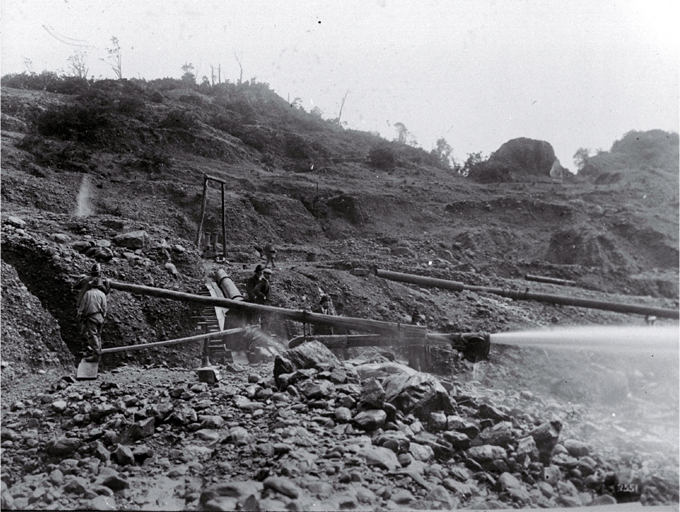
The gold sluicing fields sit on the other side of the Kawarau river, and form a scarred and battered landscape still largely empty of life. Sluicing, or hydraulic mining, invloved creating a powerful jet of water to wash away the layers of alluvial gravel while trapping the heavy gold tailings in the run off:
This canyon was created completely by sluicing, as ground level would once have been consistently high:

The canyon is now filled with tunnels and caves where miners followed promising veins of high-yielding gravel ('pay-dirt') into the hill side.


Further out from the canyons, only isolated islands of land - 'pinnacles' - remain to give an idea of what ground level once was before it was all methodically washed away. The total volume of gravel removed must have been huge. These pinnacles would have been at the corners of 'claims', and were untouched to avoid disputes as to ownership:


The water suppliers were generally the richest of all, this is all that remains of Stewart Town, the only stone house belonging to the dam owner. An orchard of apricot and pear trees is all that remains of the rest, and we had a great time finding ripe pears to refresh us.

All that gravel and earth being washed away had to go somewhere - this is the 'sludge channel' used to carry the tailings down to the river to be gone for good. Miners would have paid a charge to make use of it, and it needed regular 'flushing' due to the sludge build up!

The region is slowly recovering now, with solid gold being replaced by the liquid gold of viticulture. Animal life is still scarce, as so little grows in the scarred landscape, but this little skink was out enjoying the sun:

And we startled a family of quails out in the remains of the flushing dam:


No comments:
Post a Comment